
 Tower, Iris Bay - Office 1705 - Al Mustaqbal St - Business Bay - Dubai

Securing the Modern Enterprise: A Comprehensive Guide to Access Control Systems
An Industry Insight by Dar Al Montazah Technical Services LLC
PART 1: FOUNDATIONS, ARCHITECTURE, AND CORE TECHNOLOGIES
Introduction to Physical Security in the Digital Age
In an era defined by rapid technological advancements and evolving security threats, safeguarding physical assets, intellectual property, and human capital has become a paramount priority for businesses across the globe. Traditional lock-and-key mechanisms, once the gold standard of perimeter defense, are no longer sufficient to counter sophisticated unauthorized intrusions, internal thefts, or modern security breaches. Today, corporate security demands a dynamic, verifiable, and scalable solution. This is where modern Access Control Systems (ACS) step in, serving as the electronic backbone of contemporary facility security and operational management.
An access control system is much more than a digital lock; it is an intelligent, integrated network designed to regulate who can enter a specific area, when they are permitted to do so, and under what exact conditions. By shifting from static physical keys to dynamic digital credentials, organizations gain unprecedented command over their premises. Whether securing a single server room or managing multi-site commercial complexes, establishing a robust access network is foundational to operational integrity. As premier security integrators, Dar Al Montazah Technical Services LLC specializes in engineering bespoke deployment models that protect critical infrastructure while ensuring seamless everyday traffic flow.
How Access Control Systems Work: The Core Architecture
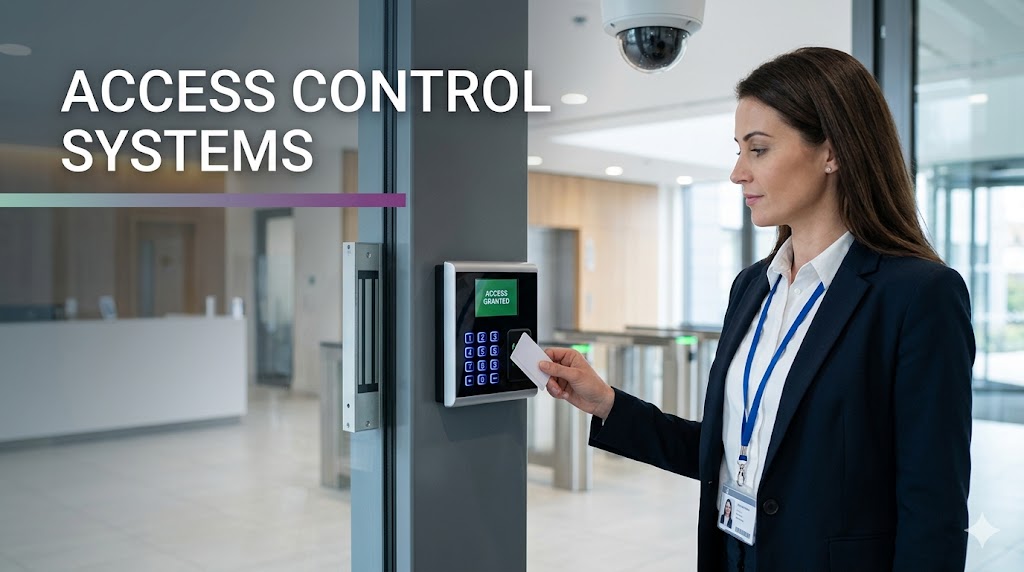
To fully appreciate the value of electronic security, it is essential to understand the underlying infrastructure that powers these systems. Every access control setup relies on a synchronized relationship between credentials, readers, control panels, and locking hardware. When an individual approaches a secured portal, the workflow operates via three sequential phases: Identification, Authentication, and Authorization.
-
The Credential: The user presents an identity token—such as a key card, key fob, smartphone app, or biometric signature—to an electronic reader interface.
-
The Reader: The reading device scans the token, extracts the encrypted identification data, and transmits it instantly to an internal controller.
-
The Intelligent Controller: Often called the “brain” of the system, the control panel cross-references this digital data against an active database of pre-configured access permissions.
-
The Lock Mechanism: If the database validates that the individual holds permission for that specific door at that precise hour, the controller sends an electrical signal to a magnetic lock or electric strike, releasing the mechanism and granting entry. Simultaneously, the system logs the event for auditing purposes.
Key Types of Access Control Frameworks
Not all security frameworks are created equal; different environments demand distinct operational philosophies. Selecting the correct control framework dictates how permissions are managed, altered, and audited across your enterprise architecture.
1. Discretionary Access Control (DAC)
Under a Discretionary Access Control framework, the owner or administrator of a specific protected asset has total control over who is allowed entry. This model offers maximum flexibility and is common in smaller operations. However, because permissions can be passed along or assigned easily by individual users, it lacks the strict security protocols required by large corporations or highly sensitive environments.
2. Mandatory Access Control (MAC)
Mandatory Access Control represents the strictest end of the security spectrum. Typically utilized by military institutions, government facilities, and critical data centers, MAC classifies all users and areas into specific security tiers. Access is centrally managed by a master administrator based strictly on clearance levels, completely removing individual user discretion from the security equation.
3. Role-Based Access Control (RBAC)
The most widely adopted framework in the corporate sector today is Role-Based Access Control. Instead of assigning permissions to individual employees one by one, access rights are explicitly tied to specific job roles within the organization. For instance, all members of the “Human Resources” tier are automatically granted access to personnel filing rooms, while the “Engineering” tier receives clearance for lab spaces. This drastically simplifies administration for growing enterprises.
Evolving Credential Technologies
The methods users employ to authenticate their identity have undergone a major transformation. Traditional proximity cards operating on unencrypted 125 kHz frequencies are rapidly being replaced due to vulnerability to cloning. Modern installations leverage smart cards with high-frequency (13.56 MHz) encryption protocols, ensuring that credentials cannot be intercepted or replicated by malicious parties.
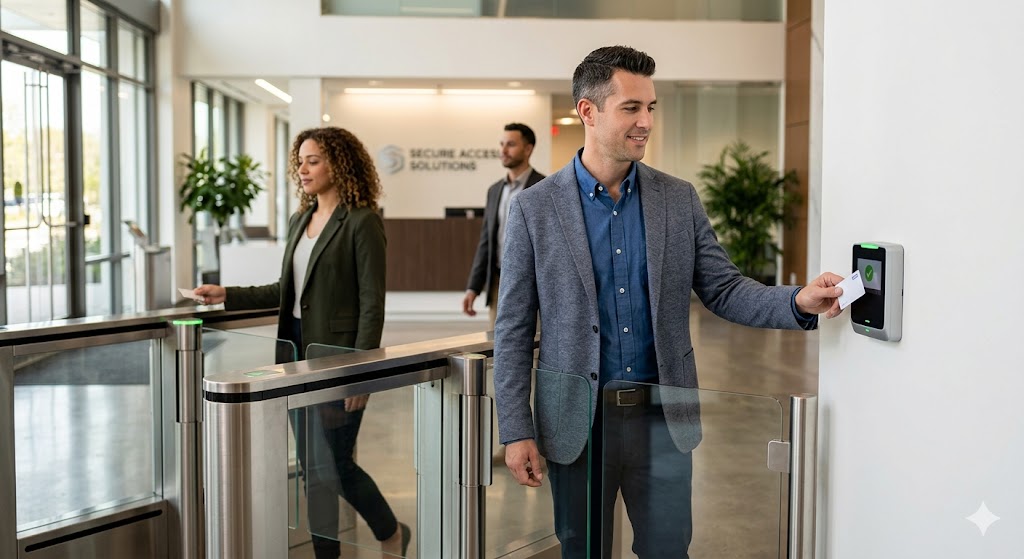
Furthermore, mobile credentialing has emerged as a disruptive trend. By using Bluetooth Low Energy (BLE) or Near Field Communication (NFC), employees can unlock doors using secure applications on their smartphones, eliminating the logistical costs of issuing physical plastic cards. For high-security sectors, biometric validation—including fingerprint scanning, facial recognition, and iris tracking—provides the ultimate defense, ensuring that the person presenting the credential is undeniably who they claim to be.
ENTERPRISE BENEFITS, INTEGRATION, AND IMPLEMENTATION STRATEGIES
Strategic Benefits of Implementing Modern Access Control
Investing in an advanced access framework yields operational advantages that extend far beyond preventing unauthorized entry. For forward-thinking enterprise leaders, partnering with a technical systems expert like Dar Al Montazah Technical Services LLC introduces structural efficiencies, transparency, and risk mitigation strategies that protect the bottom line.
Elimination of Key Vulnerabilities and Re-keying Costs
When a physical master key is lost or stolen, the financial consequences can be staggering. Facilities must hire locksmiths to re-key dozens of doors and manufacture hundreds of new physical keys. With electronic access control, a lost card or mobile credential can be instantly revoked in the centralized cloud management software within seconds, rendering the lost token useless while preserving system integrity without extra hardware costs.
Granular Time-Based Restrictions
Unlike traditional locks, electronic systems allow administrators to enforce strict temporal controls. Maintenance crews, delivery personnel, or temporary contractors can be assigned credentials that only function during specific windows (e.g., Tuesdays from 9:00 AM to 1:00 PM). Outside of these hours, their access rights automatically lapse, eliminating potential vulnerabilities from unsupervised after-hours presence.
Comprehensive Audit Trails and Regulatory Compliance
In many modern industries—such as banking, healthcare, and logistics—maintaining clear custody records is a strict legal requirement. Access systems generate automatic, timestamped logs of every entry and denied attempt. In the event of an incident or internal breach, corporate security officers can pull historical reports instantly to verify exactly who was inside a specific zone during the event window.
The Power of System Integration
The true power of an access control system is realized when it stops operating in a silo and integrates with other infrastructure management networks. By bridging systems together, enterprises create a unified, intelligent security ecosystem capable of automated real-time threat responses.
When integrated directly with Video Surveillance (CCTV) systems, every access event or forced-door alarm can trigger nearby IP cameras to instantly capture high-definition footage of the portal and bookmark it in the Video Management Software. If an unauthorized individual attempts to scan an invalid card, security teams receive an immediate pop-up alert accompanied by a live video feed of the suspect. Similarly, integration with fire alarm systems ensures that in the event of an emergency evacuation, all electromagnetic locks instantly cut power, allowing occupants to exit cleanly through designated doors without manual intervention.
Cloud-Based vs. On-Premises Architecture
When planning a system deployment, enterprise decision-makers must choose between an on-premises architecture and a cloud-based Access Control as a Service (ACaaS) model. On-premises systems locate servers, databases, and software within the physical facility. This offers complete local control over data storage, making it attractive to highly regulated sectors. However, it requires dedicated internal IT resources to manage server maintenance, software patches, and data backups.
Conversely, Cloud-Based Access Control hosts management software on remote secure cloud servers. This allows facility managers to adjust user privileges, lock down portals, or review access logs from any web browser or mobile application anywhere in the world. Cloud frameworks eliminate the need for expensive on-site server hardware, reduce upfront capital expenditure, and ensure the system receives automatic security updates against emerging software vulnerabilities.
Best Practices for Successful Deployment and Maintenance
Designing and deploying a reliable corporate access control network requires a structured approach. To maximize your return on investment and build lasting defense layers, organizations should focus on the following deployment principles:
-
Conduct a Comprehensive Asset Assessment: Identify and categorize facility zones based on risk profiles, distinguishing standard entry points from high-security areas like server rooms or financial vaults.
-
Prioritize Intuitive User Experiences: Choose credential types that fit into employee workflows naturally to avoid operational friction and prevent workaround habits like propping doors open.
-
Implement Multi-Factor Authentication (MFA): For ultra-sensitive infrastructure zones, pair a smart card credential with a biometric scan or personal identification number (PIN) to establish comprehensive verification layers.
-
Establish Routine Preventive Maintenance: Schedule regular professional technical inspections to check backup batteries, recalibrate door alignments, clean reader optics, and test emergency release overrides.
Conclusion: Securing Your Enterprise Future
Implementing an advanced access control framework is no longer a luxury reserved for high-risk installations; it is an essential investment for any modern business dedicated to protecting its employees, intellectual property, and long-term operations. By replacing outdated lock networks with dynamic, intelligent electronic controls, organizations transition from passive reaction strategies to proactive, data-driven security management.
At Dar Al Montazah Technical Services LLC, we understand that every facility presents its own distinct operational challenges and security objectives. Our engineering teams specialize in building cutting-edge, integrated access architectures tailored to your current workflow demands while scaling seamlessly alongside your future business growth. Partner with us today to fortify your facility perimeters and elevate your operational control into a modern, secure standard.