
 Tower, Iris Bay - Office 1705 - Al Mustaqbal St - Business Bay - Dubai


Remote Mobile Monitoring Setup: A Comprehensive Technical Enterprise Guide
In an increasingly interconnected global economy, the traditional boundaries of operational environments have fundamentally dissolved. Modern commercial complexes, critical industrial sites, and distributed network infrastructures no longer rely solely on localized, desk-bound personnel to oversee health, safety, and operational continuity. The rise of decentralization demands robust architectural frameworks that put situational awareness directly into the hands of stakeholders, regardless of geographical barriers.
Remote mobile monitoring represents the pinnacle of this operational evolution. By leveraging advanced mobile applications, encrypted cloud data pipelines, and intelligent sensor arrays, modern technical setups allow systems engineers and facility managers to view live data metrics, handle urgent alerts, and execute crucial diagnostics right from their smartphones or tablets. For forward-thinking enterprises, deploying this architecture is no longer just a luxury for convenience—it is a foundational pillar of modern technical resilience, operational uptime, and preventative maintenance strategies.
Architectural Foundations of a Mobile Monitoring System
To implement an enterprise-grade mobile monitoring system, organizations must look beyond consumer-grade software and design a multi-layered ecosystem. This ecosystem must ensure real-time telemetry, low latency, and end-to-end data integrity. A reliable infrastructure generally consists of four primary technological layers:
1. Edge Data Acquisition and IoT Nodes
The system begins at the physical site, where sensors, programmable logic controllers (PLCs), network cameras, and environmental monitoring devices gather critical data. These edge devices track variables like ambient temperature, electrical load, humidity levels, and unauthorized physical access.
2. Smart Gateway Communication Hubs
Raw physical signals must be converted into structured data packets. Local communication hubs protocol-translate edge data into lightweight internet-friendly formats, using standards like MQTT (Message Queuing Telemetry Transport) or HTTPS, before securely transmitting them out of the facility.
3. Scalable Cloud Aggregation Layer
The centralized brain of the operations parses, indexes, and stores incoming telemetry streams. This cloud layer acts as a high-velocity data engine, hosting specialized API endpoints that interact directly with remote mobile interfaces.
4. End-User Mobile Interfaces
The final layer features cross-platform mobile applications engineered to render complex diagnostic dashboards smoothly on mobile screens, ensuring zero visual lag and intuitive touch control.
At Dar Al Montazah Technical Services LLC, we emphasize that a failure in any single component of this architectural chain compromises the entire ecosystem’s responsiveness, making precise hardware integration and professional configuration critical.
Step-by-Step Implementation and Engineering Setup
Setting up a remote mobile monitoring framework requires a rigorous, systematic methodology to avoid common pitfalls such as configuration gaps, communication lag, or structural vulnerabilities. Following a strict sequence ensures a resilient deployment:
Phase 1: Precision Hardware Evaluation and Positioning
Before installing a single line of software, teams must complete a comprehensive site assessment. Engineers must identify critical observation points—such as electrical switchgear rooms, server racks, or primary HVAC chillers—and install matching commercial-grade sensors. Ensuring continuous power availability through Power over Ethernet (PoE) or long-lasting lithium batteries is essential to keep edge data flowing during power outages.
Phase 2: Network Gateway and Communications Configuration
Once sensors are physically in place, they connect to a centralized onsite gateway hub. Technicians must configure network routing to allow safe outbound traffic while isolating internal machinery from direct internet exposure. This phase involves setting up local fallback storage loops, which save data locally if a broad internet outage occurs and automatically resync with the cloud once connectivity returns.
Phase 3: Secure Cloud Sync and Mobile Access Calibration
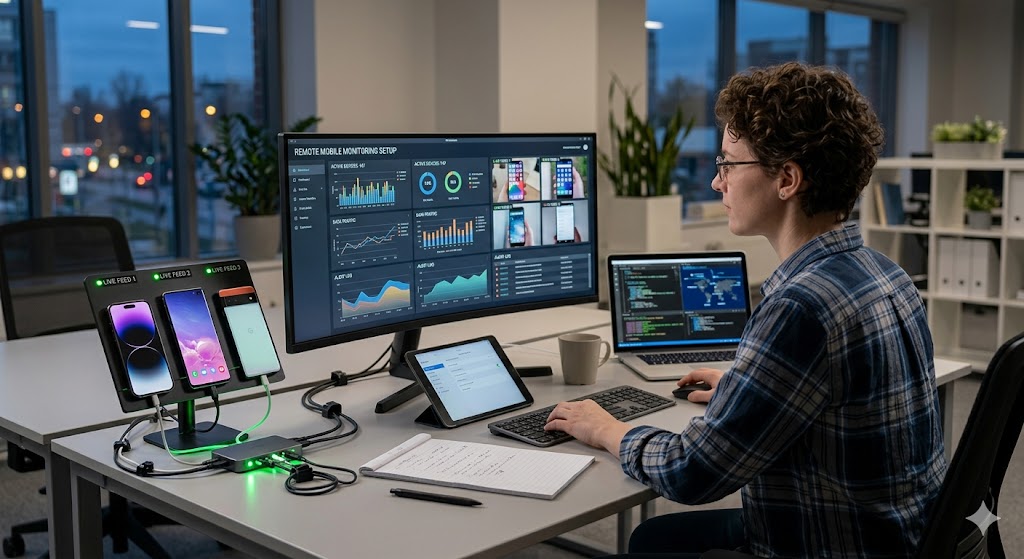
With data flowing cleanly from the gateway, attention shifts to the cloud environment. Database tables are optimized to manage rapid time-series data streams without creating performance bottlenecks. Next, engineers register mobile endpoints within the system, provisioning cryptographic device profiles and validating secure access permissions. Finally, customizable push-notification triggers are configured to instantly alert specific technicians when parameters exceed safe tolerances.
Critical Security Protocols and Data Protection
Transitioning operational metrics to a mobile ecosystem opens up new vulnerabilities if left unprotected. Securing a remote mobile monitoring network requires a defense-in-depth framework that prevents unauthorized access while ensuring fast data delivery:
End-to-End Encryption (E2EE): Telemetry data must be encrypted both in transit and at rest. Utilizing TLS 1.3 for data in motion across mobile networks and AES-256 for storage guarantees that intercepted streams remain unreadable.
Multi-Factor Authentication (MFA) & Biometrics: Relying on passwords alone is a significant security risk for critical infrastructure. Mobile applications should demand biometric authorization (such as fingerprint or facial recognition) along with hardware tokens before granting control capabilities.
Role-Based Access Control (RBAC): Not all users require identical system access. While junior technicians may only need read-only access to view environmental metrics, senior site engineers require authenticated administrative permissions to change thresholds or reset alerts remotely.
Maximizing ROI and Future Technological Horizons
Implementing an advanced remote mobile monitoring system delivers substantial, long-term returns on investment. Moving from reactive fire-fighting to data-driven maintenance allows corporations to lower emergency repair expenses, extend the lifecycle of expensive capital machinery, and minimize unexpected operational downtime.
Looking ahead, the integration of Artificial Intelligence (AI) and Machine Learning (ML) analytics will transform mobile monitoring even further. Future systems will go beyond reporting active faults to anticipate breakdowns days in advance, analyzing minor vibrations or micro-temperature shifts to flag problems early. Mobile devices will no longer just show what is happening right now—they will accurately project future maintenance needs.
Conclusion: Selecting Your Systems Integration Partner
Building a flawless, high-performance remote mobile monitoring setup demands deep technical expertise that covers physical hardware installation, cloud database optimization, and modern mobile security practices. Partnering with a proven technical services firm ensures your monitoring setup is resilient, safe, and tailored to your operational needs.
As an industry leader in technical integrations, Dar Al Montazah Technical Services LLC designs, deploys, and maintains cutting-edge remote mobile monitoring architectures for modern businesses. Our elite engineering teams align your local infrastructure with world-class cloud platforms, giving you complete visibility and control over your operations right from your mobile device. Contact our technical team today to future-proof your business infrastructure.