
 Tower, Iris Bay - Office 1705 - Al Mustaqbal St - Business Bay - Dubai

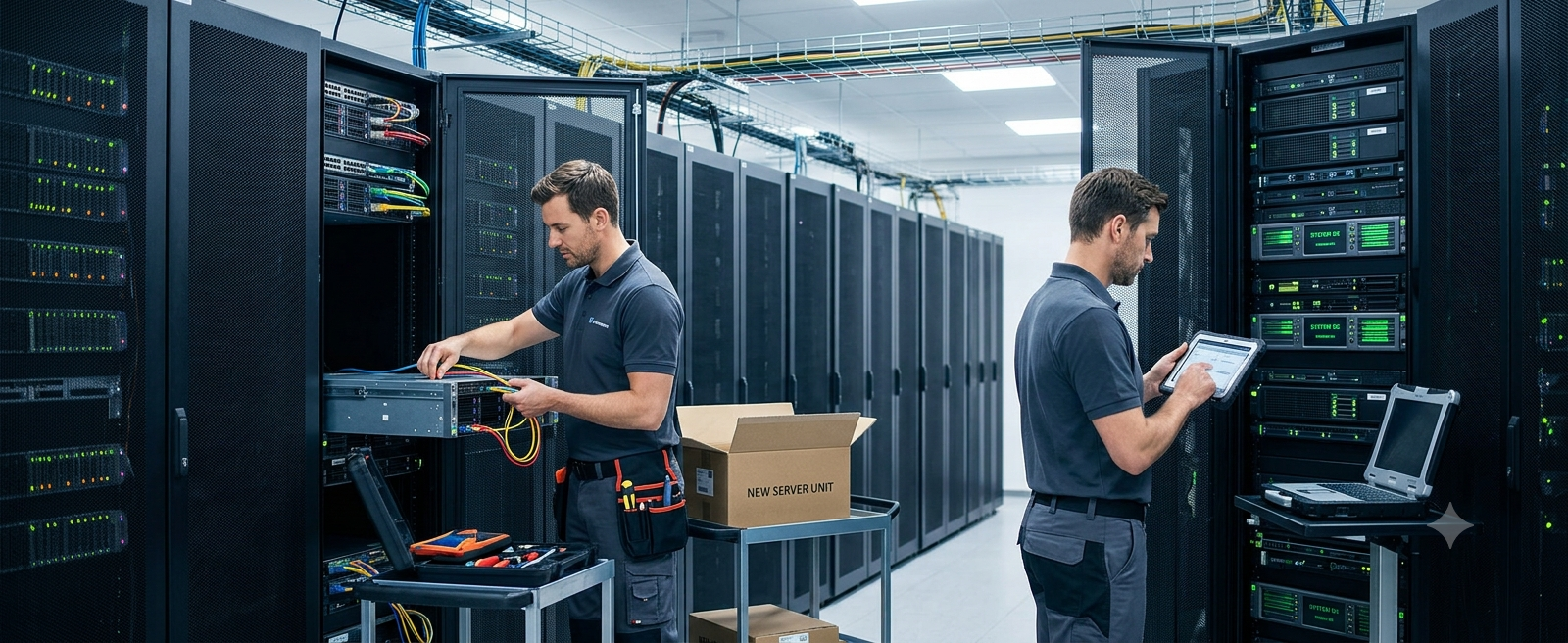
The Blueprint for Enterprise Reliability: Server Installation and Maintenance
A Comprehensive Technical Guide by Dar Al Montazah Technical Services LLC
In the contemporary digital landscape, data centers and server infrastructures serve as the foundational bedrock for any scalable enterprise operation. Whether handling intensive enterprise resource planning (ERP) systems, managing dense virtualization layers, or facilitating secure local data repositories, a server’s performance directly impacts business continuity. However, building a highly resilient server environment requires more than simply purchasing premium hardware. True structural reliability is achieved through meticulous physical installation, strategic software provisioning, and rigorous, preemptive lifecycle management.
As organizations scale, the complexity of managing server topologies scales exponentially. For modern enterprises, deploying server hardware involves careful consideration of environmental variables, networking topologies, power redundancy, and sophisticated security protocols. This comprehensive guide, prepared by the IT engineering experts at Dar Al Montazah Technical Services LLC, explores the critical phases of successful server installation and outlines the structural maintenance paradigms required to sustain peak operational efficiency.
Phase 1: Pre-Deployment Architecture and Planning
Before unboxing any rackmount hardware, an exhaustive planning phase must dictate the parameters of the deployment. Failure to map compute demands to physical constraints often results in thermal choking, power over-allocation, or structural bottlenecks within the network infrastructure.
1. Workload Assessment and Hardware Dimensioning
The core objective of structural hardware dimensioning is matching the server configuration with its target workload profile. For example, a high-volume database server demands ultra-low latency NVMe storage arrays configured in redundant RAID layouts and significant allocations of multi-channel ECC (Error-Correcting Code) RAM. Conversely, a deep virtualization host demands high-density, multi-core processors (such as AMD EPYC or Intel Xeon scalable chipsets) alongside high-bandwidth network interface cards (NICs) supporting SR-IOV (Single Root I/O Virtualization) to segment traffic seamlessly across virtual machines.
2. Environmental and Infrastructure Readiness
Servers generate substantial thermal energy and draw heavy electrical loads. At Dar Al Montazah Technical Services LLC, we emphasize verifying the following ambient data center criteria prior to server arrival:
-
Thermal Regulation: The server room must feature structured hot/cold aisle containment layouts, maintaining ambient intake temperatures between 18°C and 22°C (64°F to 72°F) to prevent thermal throttling.
-
Power Topology and Redundancy: Each server chassis must be fed by independent Power Distribution Units (PDUs) linked to separate Uninterruptible Power Supply (UPS) banks. This ensures that if an isolated circuit fails, the server’s redundant Power Supply Units (PSUs) handle the failover seamlessly without service disruption.
-
Physical Security and Rack Management: Server enclosures must be structural standard 19-inch racks equipped with functional front and rear locking doors, proper cable management arms, and adequate static grounding loops.
Phase 2: Physical Installation and Cable Infrastructure
The physical mounting phase sets the structural standard for the server’s multi-year operational lifecycle. Disorganized physical installation leads to restricted airflow, physical maintenance strain, and tracing complications during hardware faults.
1. Rack Mounting and Mechanical Stabilization
Heavy server chassis, particularly multi-node high-density chassis or storage enclosures filled with 3.5-inch spinning disks, must be mounted using heavy-duty sliding outer rails secured tightly to the server rack frame. Engineers must install heavier equipment at the bottom of the rack to maintain a low center of gravity, minimizing tipping hazards. Once securely clicked into the rack mechanisms, alignment must be checked to prevent physical chassis stress.
2. Structured Interconnect and Cable Management
Proper cabling is both an aesthetic preference and an absolute operational necessity. All network drops (CAT6A copper or OM4 multi-mode fiber) and power lines must be routed neatly through articulating cable management arms. This enables technicians to pull the server completely out of the rack for hot-swapping memory modules or fans without disconnecting running links. Every single line must be explicitly labeled at both termination ends using a standardized grid coordinate matrix pointing back to the core patch panel or top-of-rack (ToR) switch.
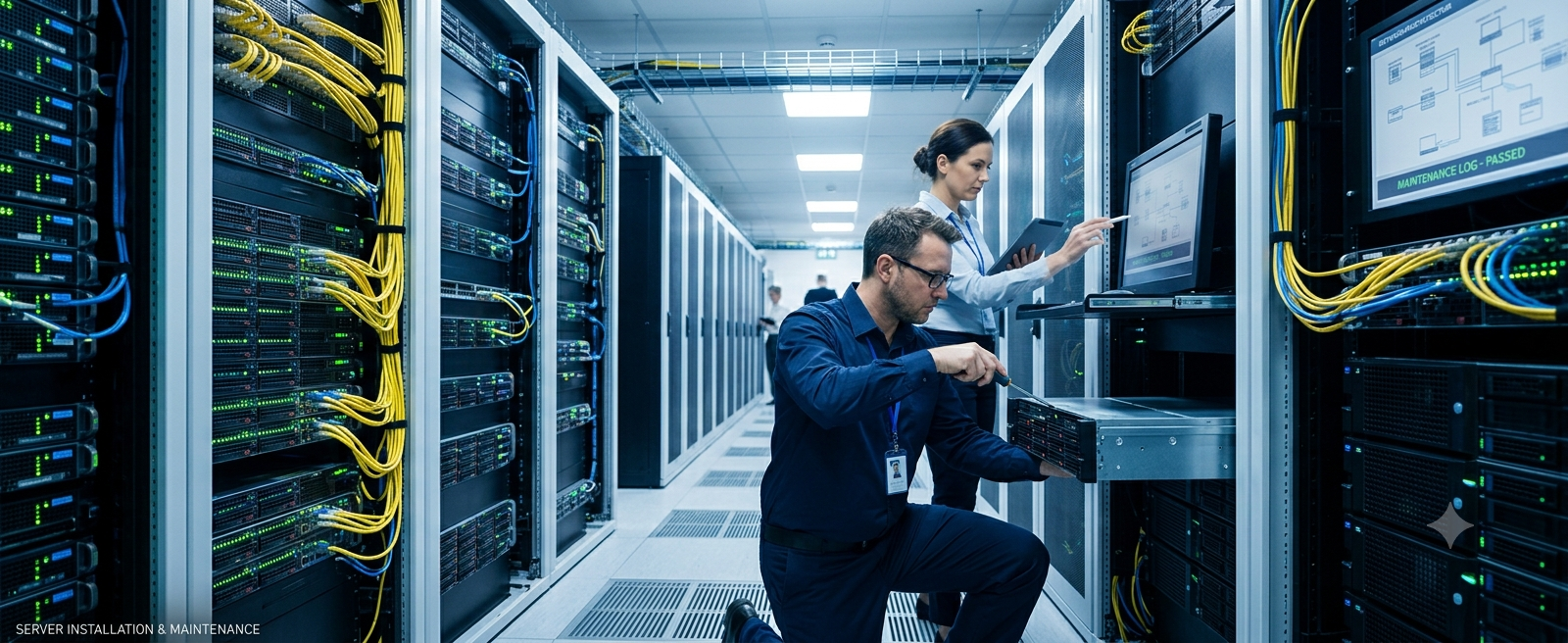
OS Provisioning, Security, & Lifecycle Maintenance
Phase 3: Operating System Provisioning and Security Hardening
With bare-metal hardware properly racked and connected, provisioning switches from physical deployment to software engineering. An unhardened, basic OS installation is a critical vulnerability that endangers internal networks.
1. Firmware Baseline Configuration
Before launching an OS installer, the system’s Unified Extensible Firmware Interface (UEFI) or BIOS must be thoroughly optimized. The technicians at Dar Al Montazah Technical Services LLC update out-of-the-box system firmware, including motherboard BIOS, hardware RAID controller microcode, and drive firmware, to the manufacturer’s latest stable release. Within UEFI, Secure Boot must be enabled, default administrator authentication profiles updated to enterprise credentials, and specialized out-of-band management platforms (such as Dell iDRAC, HPE iLO, or Lenovo XClarity) locked down on isolated Out-of-Band (OOB) management VLANs.
2. Operating System and Logical Volume Partitioning
Whether configuring Windows Server Core, Red Hat Enterprise Linux (RHEL), or a hypervisor abstraction layer like VMware ESXi or Proxmox VE, storage design is vital. System boot partitions should remain entirely isolated from production application directories. Utilizing Logical Volume Management (LVM) or ZFS datasets allows storage groups to expand dynamically over time without forcing extensive downtime to modify critical structural partitions.
3. Perimeter and Internal System Hardening
No server is permitted to communicate across production switches without immediate defense mechanisms. Operating systems must be hardened according to international security frameworks, such as CIS (Center for Internet Security) Benchmarks. This includes turning off non-essential software daemons, configuring a strict host-level firewall (like iptables or Windows Advanced Firewall), changing default SSH ports, enforcing cryptographic key-pair access methods, and introducing localized intrusion prevention utilities like Fail2ban.
Phase 4: Structured Long-Term Maintenance and Lifecycle Management
Server deployment is simply a single event; server maintenance is an ongoing, daily operational requirement. Without routine, highly structured care, servers inevitably suffer from silent hardware failure, performance decay, or catastrophic external security exploitation.
1. Patch Automation and Routine Updates
Operating system kernels, framework dependencies, and hypervisor code must receive continuous stability updates. Dar Al Montazah Technical Services LLC implements automated patch delivery frameworks that orchestrate hotfixes across target environments. Critical servers are grouped into distinct, staged deployment tracks (Development, Staging, and Production). Updates roll out systematically to secondary nodes first, ensuring applications remain online before modifying central production clusters.
2. Predictive Hardware Monitoring and Metrics Collection
Rather than waiting for a hard drive or RAM module to fail entirely, modern system management uses automated monitoring utilities like Prometheus, Grafana, or Zabbix via SNMP/IPMI protocols. These monitoring agents trace precise metrics continuously:
-
Thermal Overhead and Power Usage: Rapidly fluctuating power profiles or elevated CPU junction temperatures indicate fan failure or thermal paste degradation.
-
Storage Health Monitoring: S.M.A.R.T. monitoring tools flag incremental drive read/write block errors early, allowing technicians to replace drives seamlessly prior to storage pool degradation.
-
Resource Utilization Audits: Continual CPU, memory, and IOPS tracking flags localized application resource leaks before they cascade into system-wide crashes.
3. Disaster Recovery and Immutable Backups
No infrastructure strategy is sound without a dependable, fully verified recovery plan. Every server configuration, host database, and virtualization layer must integrate directly with automated backup routines following the time-tested 3-2-1 backup strategy. This requires keeping three independent copies of data across two distinct storage media types, with at least one copy stored securely offsite or inside an unalterable, immutable cloud repository. Backups must be tested via regular automated restore drills to ensure data integrity during real-world service restorations.
Conclusion: A Culture of Continuous Infrastructure Optimization
Achieving resilient enterprise server infrastructure is an incremental process requiring careful adherence to engineering standards. From initial planning and clean rack installation to deep operating system security hardening and automated, predictive lifecycle maintenance, every step requires specialized technical oversight.
For businesses seeking to maximize uptime, mitigate cybersecurity risks, and protect operational continuity, partnering with professional infrastructure teams is essential. The certified systems engineers at Dar Al Montazah Technical Services LLC design, build, and support tailored server infrastructures that scale securely with your enterprise goals. By implementing modern automation, proactive monitoring, and rigorous physical standards, we ensure your internal server assets remain highly available and responsive to changing business demands.