
 Tower, Iris Bay - Office 1705 - Al Mustaqbal St - Business Bay - Dubai

Introduction
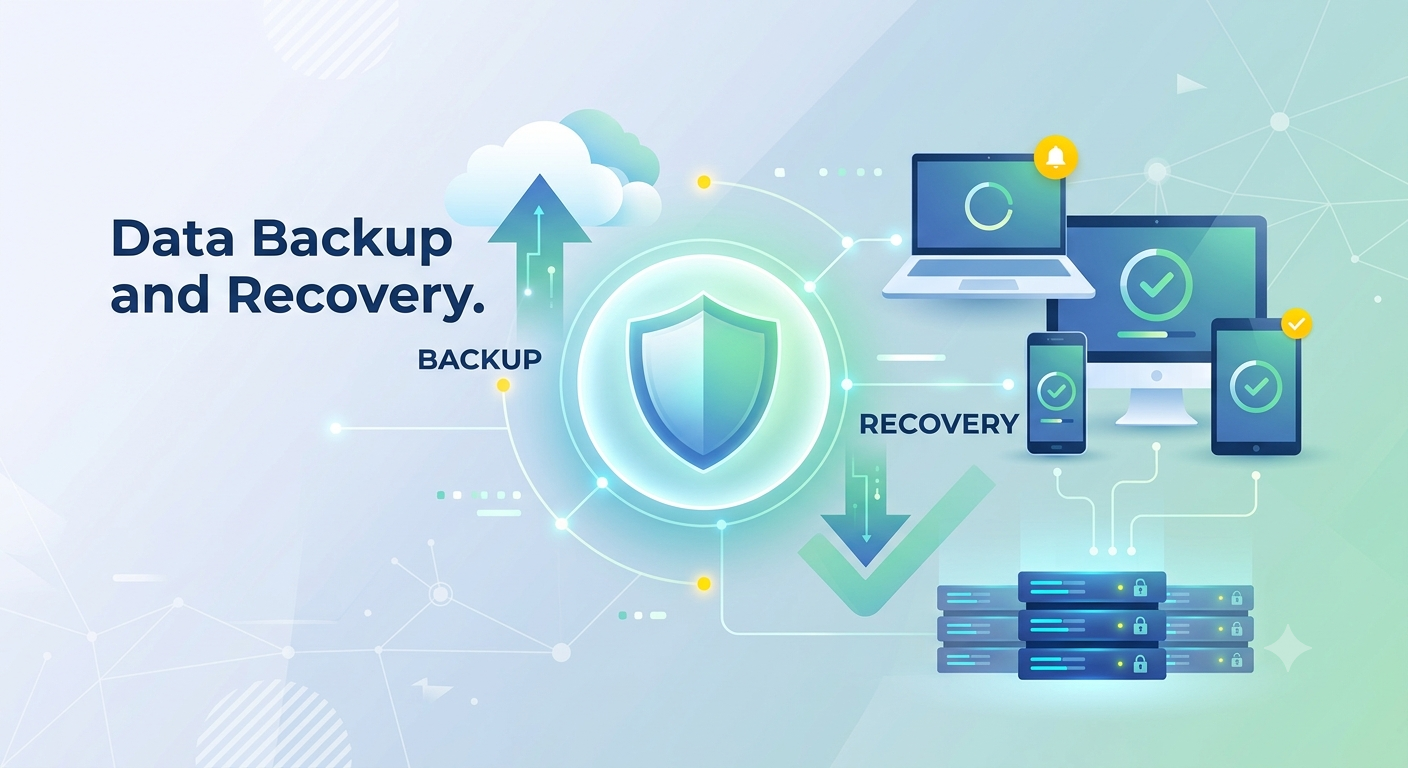
In the contemporary digital marketplace, data has evolved into the most valuable asset an organization possesses. From proprietary client records and operational configurations to complex financial transactions, digital infrastructure underpins every corporate movement. However, this absolute dependency introduces profound vulnerabilities. System failures, malicious cyberattacks, human errors, and natural disasters present constant operational hazards. When critical files disappear or server configurations become corrupted, business operations can grind to an abrupt halt, culminating in massive financial losses, legal compliance violations, and irreversible reputational degradation.
To insulate operations against these digital pitfalls, organizations must deploy rigorous strategic planning. Professional managed service providers, such as Dar Al Montazah Technical Services LLC, routinely emphasize that data backup and recovery is no longer merely a backend IT task; it is a core cornerstone of holistic corporate resilience and governance.
The Growing Vulnerabilities to Corporate Data
To grasp the foundational necessity of structured recovery frameworks, organizations must systematically identify the root threats targeting enterprise data landscapes. Hardware degradation remains an unpredictable reality; hard drives fail, power surges destroy server motherboards, and network interfaces break down unexpectedly. Concurrently, human error continues to rank among the primary drivers of localized data loss, routinely manifesting as accidental folder deletions, incorrect database script executions, or physical device damage.
Beyond internal vulnerabilities, the external threat matrix has escalated aggressively. Ransomware and sophisticated phishing networks target businesses globally, encrypting corporate databases and forcing prolonged operational paralyzation. Without decoupled, pristine copies of historical operational data, organizations find themselves trapped between paying exorbitant ransoms or permanently sacrificing their proprietary operational intelligence.
The Architecture of Modern Data Backups
Constructing a resilient backup architecture demands a granular understanding of differing replication methodologies. A balanced strategy integrates multiple backup types to optimize data storage efficiency, control network bandwidth utilization, and accelerate data restoration speeds:
-
Full Backups: This methodology clones the entire targeted data ecosystem—including operating systems, structural application data, and localized user directories—into a singular storage volume. While providing the most straightforward, single-step operational restoration process, full backups demand extensive storage capacities and lengthy execution windows.
-
Incremental Backups: Designed to conserve network bandwidth and local storage resources, incremental backups identify and copy only the data changes that occurred after the most recent backup operation—regardless of whether that operation was full or incremental. This reduces nightly processing times but requires a sequential chain of records during recovery.
-
Differential Backups: Striking a structural middle ground, differential backups replicate all structural modifications executed since the last full backup. This model slightly inflates daily storage consumption relative to incremental methodologies but drastically streamlines restoration timelines by requiring only the foundational full backup and the latest differential file.
Designing an Enterprise Backup Strategy: The Golden 3-2-1 Rule
A resilient data backup strategy is defined by systematic redundancy. Industry experts and technical consultants uniformly advocate for the implementation of the historic 3-2-1 backup paradigm. This rule mandates that a corporation must maintain three distinct copies of its operational data: one primary operational dataset and two separate backup iterations.
Furthermore, these backups must be stored across two completely different media formats—such as local Solid-State Drive (SSD) storage arrays and decoupled network-attached storage (NAS) units. Finally, at least one of these backup sets must be moved to an offsite location or structured cloud repository. Adhering to this structured blueprint guarantees that even if a catastrophic localized incident destroys an entire physical office, the organization’s foundational data remains securely accessible from isolated, offsite environments.
Recovery Metrics, Implementation, and Optimization
The Crucial Link: Understanding Backup vs. Recovery
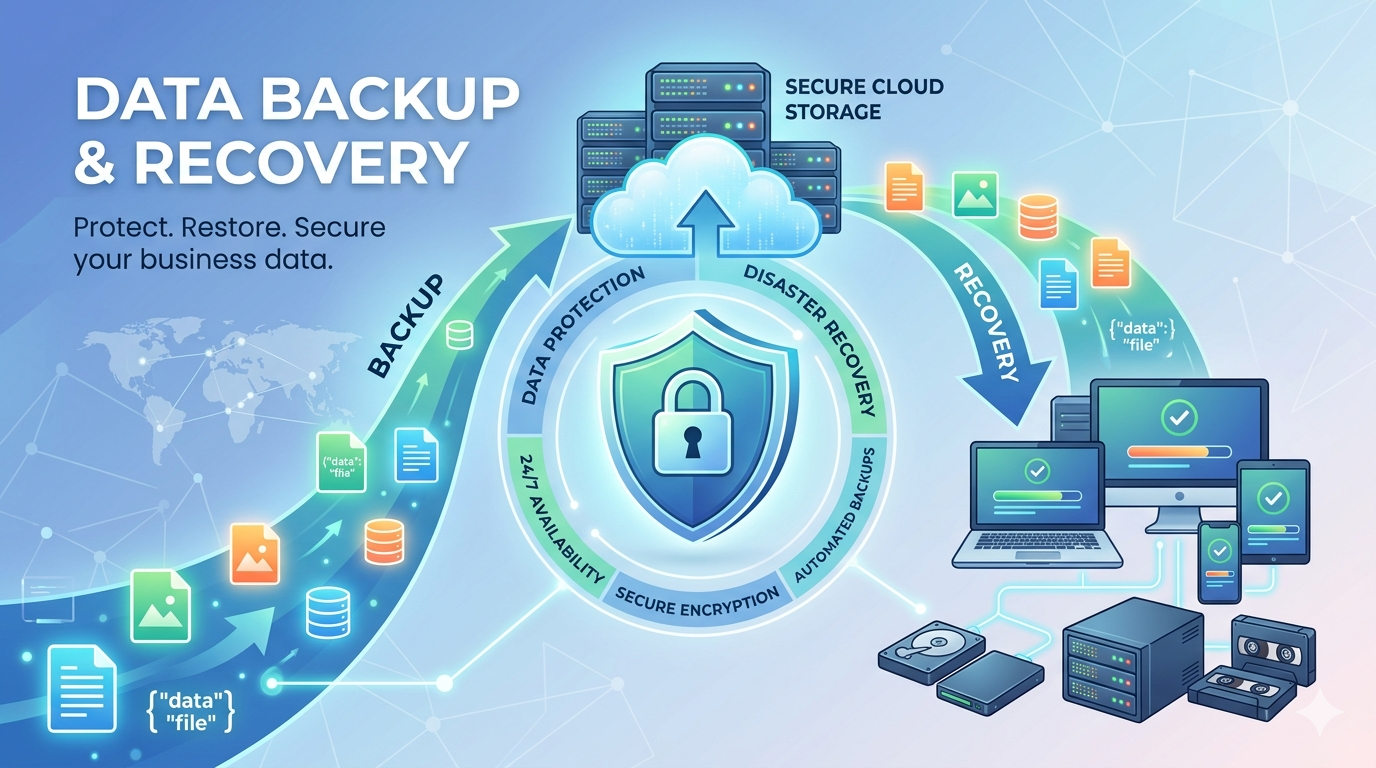
A dangerous operational misconception plagues many corporate spaces: equating successful backup generation with comprehensive disaster recovery. A backup is simply the passive act of duplicating and archiving data onto a secondary volume. Recovery, conversely, represents the dynamic deployment of protocols, software solutions, and physical assets required to retrieve those archived files and restore disrupted business applications to active production environments. Collecting snapshots means very little if your engineering teams cannot spin up operational servers within an acceptable time window following a major system crash. True organizational resilience requires meticulous alignment between data capture workflows and the technical recovery mechanisms designed to process those archives during a crisis.
Defining Critical RTO and RPO Target Metrics
To transition data recovery from an abstract concept into an actionable engineering strategy, corporations must define clear operational metrics. The two most critical pillars in disaster recovery engineering are Recovery Time Objective (RTO) and Recovery Point Objective (RPO):
-
*Recovery Time Objective (RTO): * How long can you afford to be down? This metric dictates the absolute maximum duration of allowable downtime a business can sustain before system restoration must be fully realized. For instance, an e-commerce platform might set an RTO of 30 minutes to prevent cascading revenue losses, whereas a back-office archival platform might tolerate an RTO of 24 hours.
-
Recovery Point Objective (RPO): How much data can you afford to lose? This metric measures data tolerance, defining the maximum volume of data loss an organization can endure measured in elapsed time. If a database undergoes a backup execution once every 24 hours at midnight, and a catastrophic system crash occurs at 11:00 PM, nearly 23 hours of transactional data is lost. For financial and transactional platforms, RPOs must often be reduced to minutes or seconds through real-time replication.
The Indispensable Need for Regular Testing and Drills
An untested backup strategy is an active vulnerability. Far too many enterprises only discover that their backup files are corrupted, incomplete, or unreadable during an actual live emergency. System updates, changing folder permissions, and automated script alterations can subtly break backup workflows without triggering obvious system warnings.
To counter this risk, organizations must establish a routine schedule of simulation drills. IT teams must deliberately take systems offline, attempt to mount historical snapshots, and carefully measure actual restoration timelines against established RTO and RPO metrics. Continuous validation ensures that software configurations remain compatible and that staff are trained to execute recovery procedures smoothly under high-pressure scenarios.
Securing Your Infrastructure with Professional Managed IT Support
Building, managing, and continually auditing an airtight backup and recovery ecosystem demands deep specialized expertise, dedicated infrastructure, and constant vigilance. For expanding enterprises, attempting to handle these advanced operations internally often pulls vital internal personnel away from core revenue-generating business initiatives.
Partnering with a specialized external technology consultant like Dar Al Montazah Technical Services LLC addresses this operational gap. Professional technical teams design personalized storage plans tailored to your specific infrastructure, configure secure cloud integrations, implement end-to-end encryption for idle and in-transit data, and provide round-the-clock monitoring to handle data anomalies before they escalate into business-altering events.
Conclusion
Data backup and recovery is not an optional operational insurance policy; it is a fundamental pillar of modern business governance. As cybersecurity threats grow increasingly sophisticated and corporate operational dependency on cloud data intensifies, the cost of data negligence scales exponentially. By understanding different backup methodologies, implementing the 3-2-1 redundancy rule, explicitly defining clear RTO and RPO thresholds, and continuously testing restoration protocols, your enterprise can confidently navigate unexpected technological disruptions.
Do not wait for a critical infrastructure failure or a malicious ransomware event to audit your security postures. Securing your corporate assets today with professional technical services ensures your organization remains operational, compliant, and fully protected against whatever the digital future holds.