
 Tower, Iris Bay - Office 1705 - Al Mustaqbal St - Business Bay - Dubai

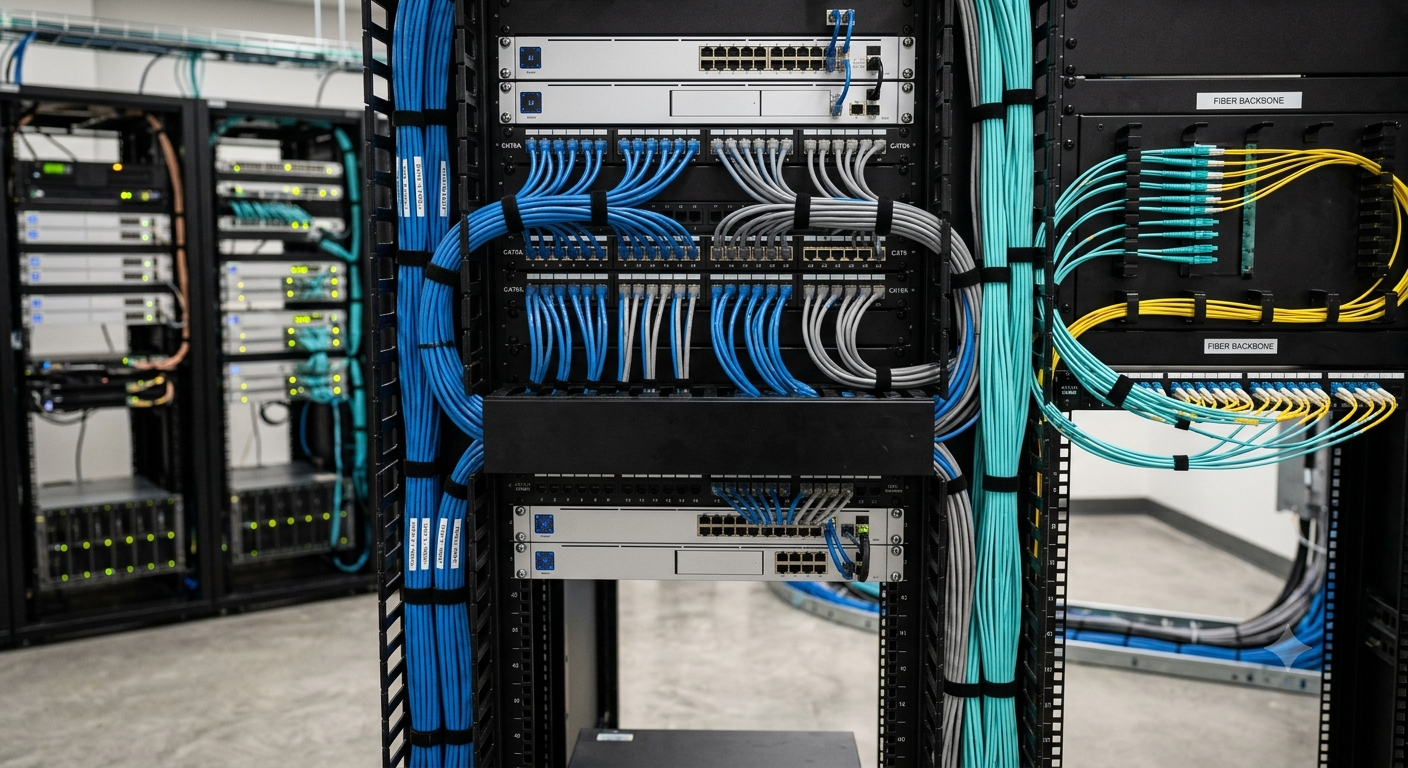
STRUCTURED CABLING SYSTEMS: THE BACKBONE OF MODERN BUSINESS CONNECTIVITY
THE FOUNDATION OF NETWORK INFRASTRUCTURE
In the modern digital landscape, data is the lifeblood of any successful enterprise. From cloud computing and real-time communication to high-definition video conferencing and smart building automation, the demand for fast, reliable, and secure data transmission has never been higher. However, many organizations overlook the critical physical infrastructure that makes this connectivity possible: the cabling system.
A poorly planned network infrastructure leads to frequent downtime, slow data transfers, and difficult troubleshooting. This is where structured cabling comes into play. By replacing chaotic, point-to-point wiring setups with an organized, standardized architecture, businesses can ensure their networks are prepared for both today’s operational demands and tomorrow’s technological advancements.
For businesses looking to implement a future-proof, high-performance infrastructure, partnering with an expert provider like Dar Al Montazah Technical Services LLC ensures that your cabling architecture is designed and deployed to the highest engineering standards.
Understanding Structured Cabling Architecture
Structured cabling is defined as a complete system of cabling and associated hardware, which provides a comprehensive telecommunications infrastructure. This infrastructure serves a wide range of uses, such as providing telephone service or transmitting data through a computer network. Unlike proprietary or haphazard installations, structured cabling adheres to strict international standards set by organizations like ANSI/TIA/EIA.
A standard structured cabling system is divided into six distinct subsystems:
-
Entrance Facilities (EF): The point where the service provider’s wiring interacts with the building’s internal infrastructure.
-
Equipment Rooms (ER): Space housing complex equipment like servers, routers, and main cross-connects.
-
Backbone Cabling: The core internal highway that connects entrance facilities, equipment rooms, and telecommunications rooms across different floors or sections.
-
Telecommunications Rooms (TR): Localized closets containing patch panels and switches that bridge backbone cabling to horizontal runs.
-
Horizontal Cabling: The wiring that extends from the telecommunications room to individual work area outlets.
-
Work Area Components: The final leg connecting end-user devices (computers, IP phones, printers) to the wall outlets.
By structuring the network this way, any modification, move, or upgrade can be handled efficiently without disrupting the entire system.
Copper Cabling Standards: CAT6 vs. CAT6A
Copper cables remain the standard choice for horizontal cabling runs due to their cost-effectiveness, flexibility, and support for Power over Ethernet (PoE). However, selecting the right category of cable is critical for performance longevity.
Category 6 (CAT6) Cabling
CAT6 is currently the baseline standard for commercial office environments. It consists of four twisted pairs of copper wires, often separated by a physical spline to reduce crosstalk (internal signal interference).
-
Speed & Bandwidth: CAT6 supports data transfer speeds up to 1 Gigabit per second (Gbps) at a bandwidth of 250 MHz over the standard maximum distance of 100 meters.
-
High-Speed Performance: It can support 10 Gbps speeds, but only over a limited distance of up to 37 to 55 meters depending on the crosstalk environment.
-
Best Used For: Standard office environments, desktop connectivity, voice networks, and basic IP surveillance setups.
Category 6A (CAT6A) Cabling
The “A” in CAT6A stands for Augmented. This standard was developed to handle the strict requirements of 10 Gbps data transmission over the full 100-meter horizontal channel length.
-
Bandwidth & Frequency: CAT6A operates at frequencies up to 500 MHz, double that of CAT6.
-
Crosstalk Mitigation: It features tighter twists and enhanced shielding (often utilizing individual foil wrapping around pairs or an outer braided shield) to eliminate Alien Crosstalk (ANEXT), which is electromagnetic interference from adjacent cables.
-
Future-Proofing: CAT6A is mandatory for supporting high-power PoE (PoE++), Wi-Fi 6/6E/7 access points, and modern data center top-of-rack deployments.
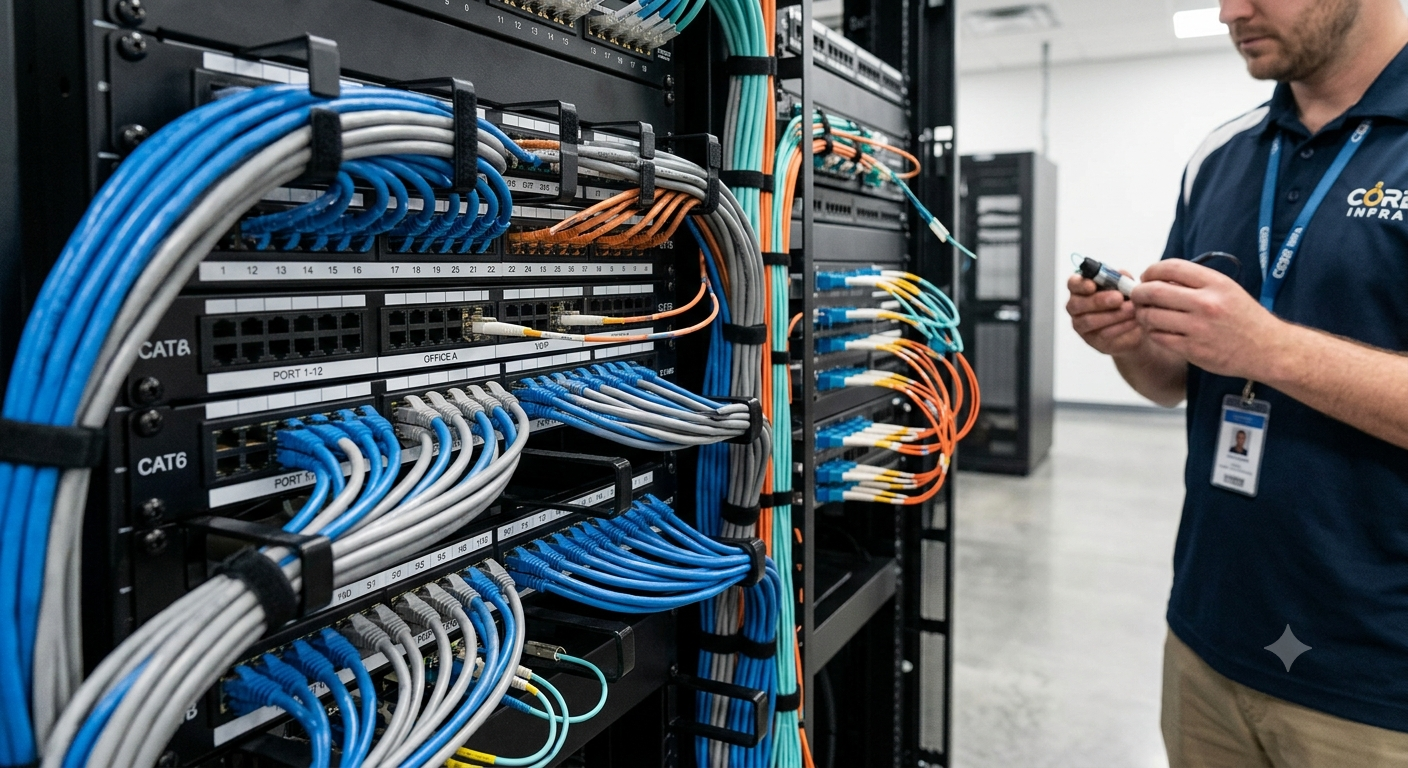
ADVANCED OPTICAL FIBER AND STRATEGIC ADVANTAGES
Optical Fiber Cabling: Breaking Distance and Speed Barriers
While copper cables excel in short-distance horizontal runs, optical fiber is the undisputed champion for backbone distribution, multi-floor connections, inter-building links, and high-density computing environments. Fiber optic technology transmits data as pulses of light through thin strands of glass, offering near-limitless performance.
Fiber cabling is categorized into two main types:
1. Multimode Fiber (MMF – OM3/OM4/OM5)
Multimode fiber features a larger core (typically 50 microns), allowing multiple modes or paths of light to travel down the core simultaneously.
-
Distance & Speed: It is highly effective for short-range applications, supporting speeds up to 40 Gbps and 100 Gbps over distances up to 300 to 400 meters.
-
Cost Efficiency: The optical transceivers required for multimode systems are significantly less expensive than those for single-mode systems, making it the preferred choice for internal enterprise backbones and data center fabrics.
2. Single-mode Fiber (SMF – OS1/OS2)
Single-mode fiber features a tiny core (around 9 microns) that allows only a single pathway of light to propagate. This virtually eliminates modal dispersion (signal distortion).
-
Distance & Speed: Single-mode fiber can carry immense bandwidth across staggering distances—frequently spanning 10 to 40 kilometers or more without requiring signal regeneration.
-
Best Used For: Campus backbones, metropolitan networks, service provider links, and linking geographically separated facilities.
Key Business Benefits of Standardized Structured Cabling
Investing in a professionally engineered structured cabling system from Dar Al Montazah Technical Services LLC delivers major long-term strategic benefits to an organization:
-
Reduced Downtime and Rapid Troubleshooting: Standardized labeling, color-coded patch cords, and systematic routing via patch panels make it incredibly easy for IT personnel to isolate and resolve cable faults within minutes rather than hours.
-
Scalability and Seamless Upgrades: A structured layout ensures that adding new workstations, upgrading network switches, or migrating to faster technologies requires minimal architectural changes. The plug-and-play nature saves substantial operational costs over time.
-
Aesthetic Organization and Enhanced Airflow: Messy “spaghetti wiring” in server racks blocks airflow, causing equipment to overheat and fail prematurely. Proper cable management preserves airflow and keeps hardware operating at peak efficiency.
-
Support for Smart Technologies: Modern buildings rely on Internet of Things (IoT) sensors, smart lighting, automated access control, and IP cameras. Structured copper and fiber lay down a cohesive highway capable of powering and connecting these diverse systems simultaneously.
The Implementation Process
A successful deployment requires careful engineering and execution, consisting of:
-
Site Assessment & Design: Analyzing building blueprints, estimating user density, and mapping out structural bottlenecks to formulate a custom topology.
-
Pathway Construction: Installing cable trays, conduits, and J-hooks to support the structural weight and maintain mandatory bend radiuses.
-
Pulling and Termination: Deliberately feeding copper or fiber cables through pathways and terminating them precisely onto patch panels and keystone jacks.
-
Testing and Certification: Utilizing advanced field testers (like Fluke Network analyzers) to verify every link against TIA standards for attenuation, return loss, and crosstalk, providing a certified documentation report.
Conclusion
Your physical network layer is the foundation upon which your entire corporate software, hardware, and communication strategy rests. Utilizing outdated or unorganized cabling guarantees a bottleneck in your operations. By transitioning to a premium copper (CAT6/CAT6A) and optical fiber infrastructure, your enterprise unlocks maximum speed, complete dependability, and effortless scalability. To ensure your network infrastructure is executed perfectly from design to final certification, trust the certified engineering professionals at Dar Al Montazah Technical Services LLC to build the reliable backbone your business deserves.