
 Tower, Iris Bay - Office 1705 - Al Mustaqbal St - Business Bay - Dubai

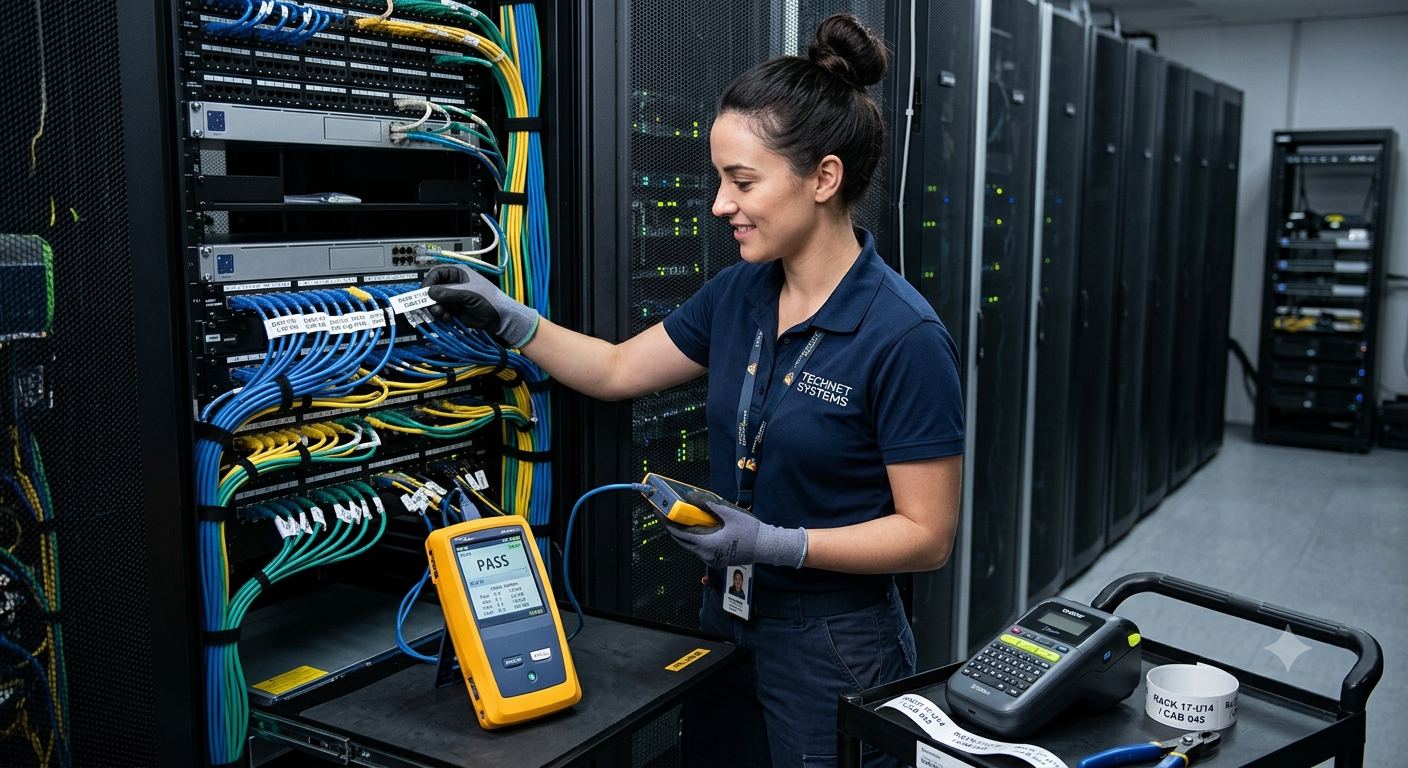
The Definitive Guide to Structural Cable Testing and Labeling
In the modern digital landscape, structured cabling architecture forms the literal nervous system of enterprise IT infrastructures, data centers, and commercial facilities. A flawless deployment ensures high-speed data transmission, operational continuity, and scalability. However, the integrity of this physical layer is entirely dependent on two critical post-installation phases: rigorous testing and systematic labeling. Without these processes, mapping errors, physical defects, and documentation gaps can degrade network capacity and cause exponential delays during troubleshooting.
As a premier infrastructure engineering partner, Dar Al Montazah Technical Services LLC prioritizes these foundational standards to deliver resilient, future-proof network environments. This comprehensive industry article explores the operational methodologies, industry standards, and best practices governing cable testing and labeling.
Network Architecture & Cable Testing Methodologies
The Crucial Role of Structural Cable Testing
Cable testing is the comprehensive technical validation process executed to prove that a newly installed physical medium meets precise mechanical and electrical performance criteria. During deployment, cables are vulnerable to various mechanical stresses including over-tensioning, exceeding the minimum bend radius, crushing, and physical jacket cuts. Testing ensures that the structural medium can support high-bandwidth protocols without signal deterioration or structural loss.
Standard Levels of Cable Testing
In industry frameworks, cable assessment is segmented into three distinct functional levels, each requiring specialized instrumentation and delivering varying depths of data insights:
-
Verification: The baseline operational tier. Verification testers check the core physical continuity of the copper links. They confirm whether the wire pairs are mapped and connected to the correct termination pins, identifying immediate structural anomalies like open circuits, short circuits, split pairs, or reversed wiring configurations.
-
Qualification: The functional testing tier. Qualification instruments evaluate whether an existing or newly laid cable link can support specific network speed and bandwidth standards (e.g., 100BASE-TX, 1000BASE-T, or 10GBASE-T). It establishes if the physical medium meets the bandwidth requirements for the specific software/hardware intended to run over it.
-
Certification: The highest and most rigorous testing tier. Certification is mandatory for commercial installations. It utilizes precision diagnostic tools to perform comprehensive parametric calculations against stringent industry standards defined by organizations like the Telecommunications Industry Association (TIA) and the International Organization for Standardization (ISO). Certification guarantees compliance and protects long-term infrastructure investments.
Key Performance Metrics in Copper and Fiber Optic Cable Testing
To certify copper infrastructure (such as Category 6, 6A, or 8 networks), professional instruments analyze several advanced signal degradation metrics:
-
Insertion Loss (Attenuation): The reduction in signal strength as it propagates down the physical length of the cable run. This is typically caused by electrical resistance within the copper core and dielectric absorption across the insulation layer.
-
Near-End Crosstalk (NEXT): An electromagnetic disturbance metric measuring the unwanted signal coupling from one wire pair to another at the transmitting end. It occurs due to stray capacitive or inductive fields leaking between adjacent wires.
-
Return Loss: A measurement of signal reflections sent back toward the transmitter source. This is primarily triggered by structural impedance discontinuities along the cable length, caused by manufacturing inconsistencies or improper installation pulling techniques.
For high-capacity fiber optic networks, Dar Al Montazah Technical Services LLC deploys advanced optical characterization tools. Testing moves beyond continuity to evaluate optical insertion loss via an Optical Loss Test Set (OLTS) and trace precise attenuation events along a fiber run utilizing an Optical Time-Domain Reflectometer (OTDR). OTDR trace profiling detects microscopic splice fractures, macrobends, and connector irregularities with precise physical distance mapping.
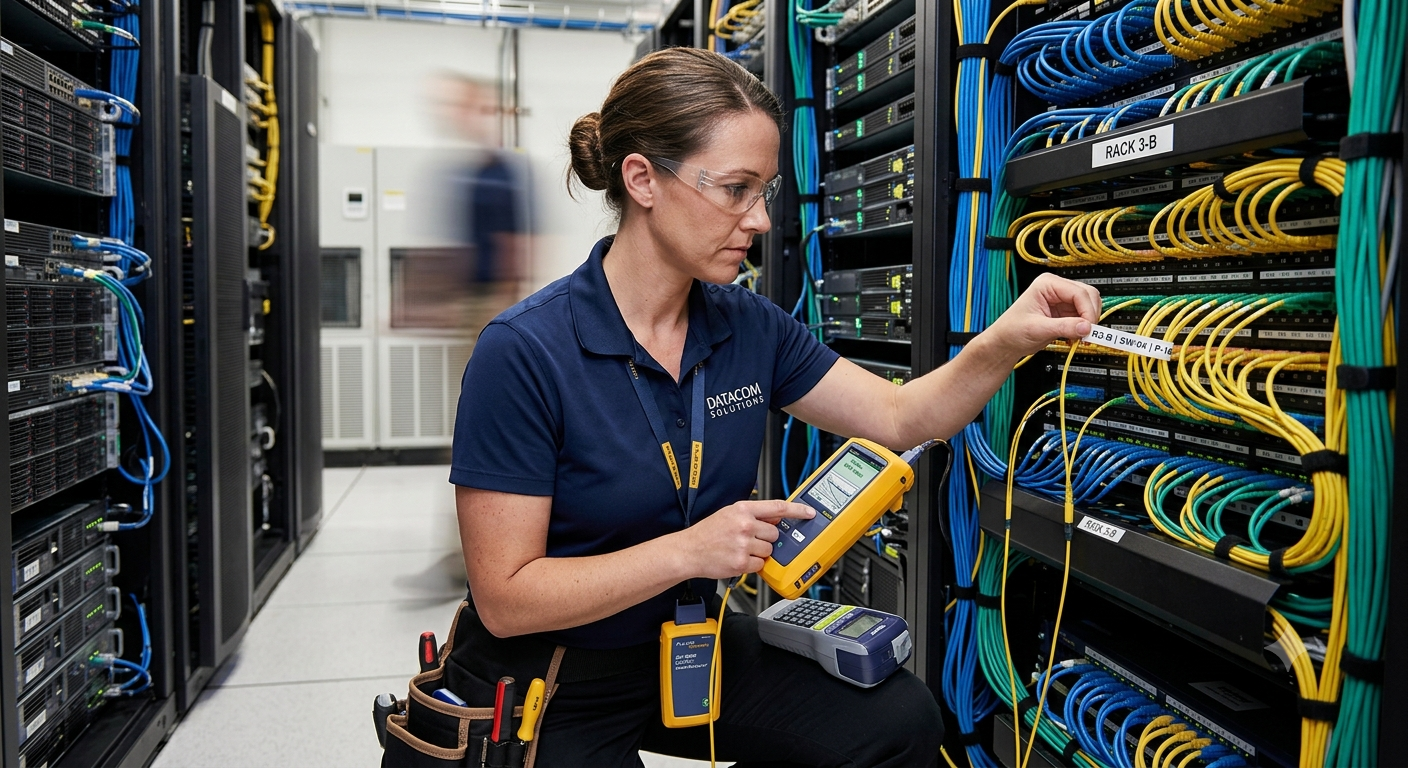
Regulatory Standardization & Systematized Cable Labeling
The Architecture of Systematic Cable Labeling
While testing validates the immediate electrical and optical integrity of a network layout, standardized labeling establishes its long-term operational viability. In multi-rack enterprise environments or modern high-density data centers, unstructured, unlabelled, or poorly color-coded wiring manifests as a significant technical liability. A lack of clear labeling prolongs Mean Time to Repair (MTTR), complicates routine MAC (Moves, Adds, and Changes) procedures, and increases the risk of human error causing unintended downtime.
Adhering to Global Standards: ANSI/TIA-606-C Framework
To ensure uniform operational clarity, professional enterprise network installations conform strictly to the ANSI/TIA-606-C standard (Administration Standard for Telecommunications Infrastructure). This regulation mandates explicit identification requirements across all physical layer components, including cables, optical paths, patch panel ports, termination blocks, pathways, grounding busbars, and equipment racks.
The standard establishes four administrative classes depending on enterprise scale:
-
Class 1: Addresses basic single-room telecommunications spaces. It requires labeling of all patch panels, link ports, and backbone terminations within that localized footprint.
AKCP -
Class 2: Governs single-building enterprise networks spanning multiple telecommunications rooms. It introduces mandatory cross-room identifiers and strict grounding topology labeling.
-
Class 3: Designed for multi-building corporate campuses, integrating building, pathway, and campus backbone identifier protocols into the asset schema.
-
Class 4: Encompasses massive multi-site, multi-geography global corporate networks, requiring sophisticated geographic and multi-tenant infrastructure tagging systems.
Standard Formatting Structure for Identifiers
A typical professional labeling sequence follows a programmatic spatial-hierarchical identifier layout, such as 1A-B24 or Building-Room-Rack-Panel-Port. For example, under a standard TIA-606-C scheme, a label reading 2B.R04-P02:12 completely breaks down the location path: 2nd Floor (2), Telecommunications Closet B (B), Server Rack Row 4 (R04), Patch Panel 2 (P02), Port Number 12 (12). This allows network technicians to rapidly isolate paths across the building without tracing cables manually across ceilings.
Best Practices in Label Materials and Physical Placement
The physical application of labels must be executed with specialized materials capable of withstanding environmental degradation. Utilizing hand-written masking tape or cheap paper labels is a serious compliance failure. Enterprise installations utilize thermal-transfer, self-laminating vinyl or polyolefin wrap-around labels that are smudge-resistant, flame-retardant, and chemically stable against ambient temperature shifts.
Labels are applied consistently within 100mm to 150mm of each termination point, ensuring high visibility at both the source workstation outlets and the central server room patch panels. This uniform placement guarantees that technician lines-of-sight remain unobstructed during maintenance procedures.
Conclusion: Building Resilient Digital Infrastructure
Strategic compliance with rigorous cable testing and labeling frameworks transforms a complex physical network from a chaotic asset into a highly manageable, highly optimized IT environment. Comprehensive testing provides absolute assurance of high-fidelity signal performance, while systematic labeling ensures rapid diagnostics, minimal operational downtime, and low-risk hardware scaling.
Through systematic adherence to international standards like TIA-606-C and precise diagnostic certification workflows, Dar Al Montazah Technical Services LLC remains a trusted engineering partner across the UAE region, delivering scalable structured cabling architectures that support next-generation enterprise technology.